
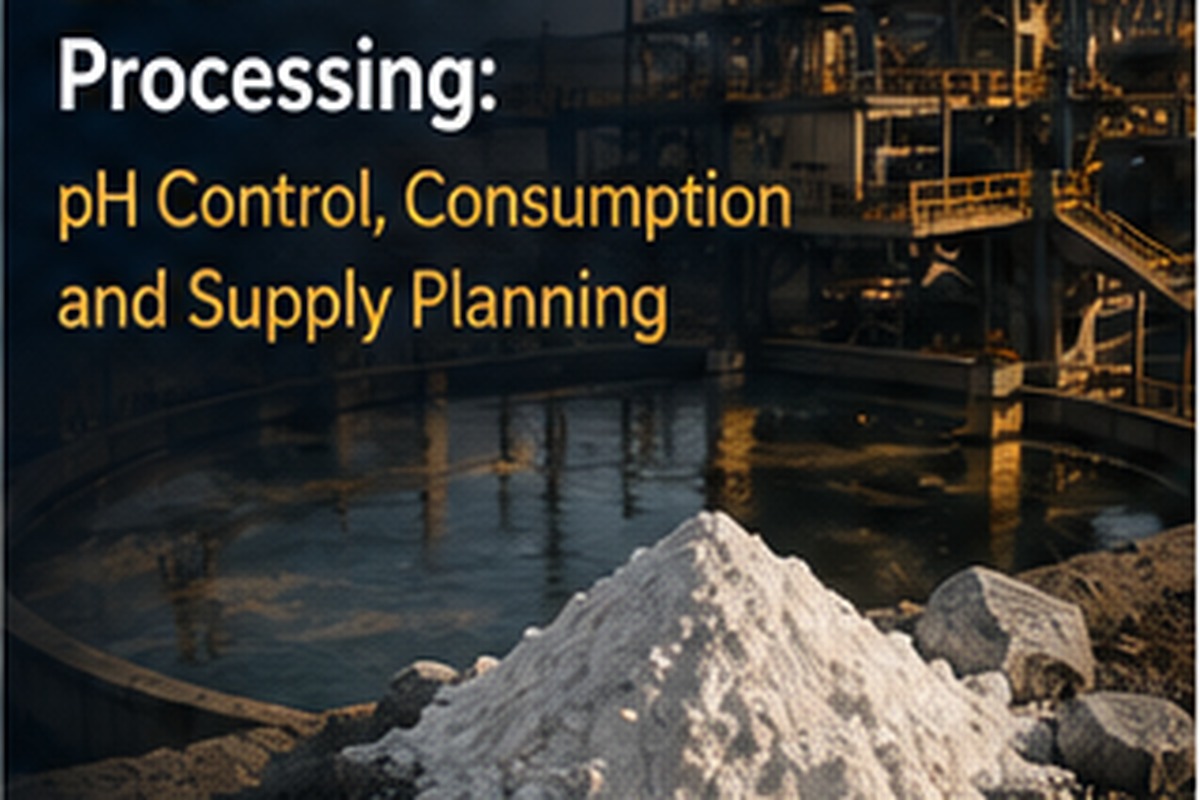
Lime looks simple until the plant starts using more of it
For many gold operations, lime is such a familiar reagent that it is easy to treat it as a straightforward commodity purchase. The plant needs lime, procurement asks for quotations, a supplier delivers, and the cycle continues. The difficulty is that two products sold under the same broad description can behave very differently once they reach the process.
In cyanide-based gold processing, alkaline conditions form part of the plant’s process and cyanide-management strategy. Lime is commonly used to provide that alkalinity. If quality or reactivity changes, operators may compensate by increasing dosage. The plant may still hit its pH target, so the problem can hide in plain sight until somebody notices that monthly lime consumption has climbed.
This is why the useful question is not simply, “What is the price per tonne?” It is, “What does this tonne actually do for our process?”
Quicklime and hydrated lime are not interchangeable line items
A quotation that simply says “lime” leaves too much unanswered. Is the requirement quicklime or hydrated lime? What grade has the plant approved? What level of available lime or other quality parameters matter? How will the product be received, stored and prepared?
These questions have commercial consequences. Product form affects how much active material is being transported, the equipment needed on site, storage arrangements and handling. A mine designed around a particular preparation system cannot casually change product form because another quotation looks cheaper.
Before procurement compares prices, metallurgy and operations should make the requirement unambiguous. That single step removes a surprising amount of risk from the purchasing process.
A cheaper tonne can become an expensive pH target
Imagine Supplier A is cheaper by a comfortable margin. The first deliveries arrive and nothing dramatic happens. A few weeks later, however, operators are feeding more lime to maintain the same process conditions. The purchase price went down, but consumption went up.
That is the kind of saving that disappears when the full operating picture is considered. Available lime, reactivity, impurities and physical characteristics can all influence how a product performs. Ore and process conditions can also change, so a rise in consumption is not automatically the supplier’s fault. The point is that the mine needs enough data to tell the difference.
A simple trend of tonnes of lime consumed against tonnes of ore treated can be more revealing than a stack of supplier quotations.
The preparation system deserves a seat at the procurement table
Lime does not move from truck to process by magic. Depending on the operation, it may pass through silos, conveyors, slakers, mixing systems, pumps and dosing equipment. Physical characteristics that look insignificant on a specification sheet can become very significant when material starts bridging, generating excessive dust or preparing inconsistently.
That is why engineering and operations should be involved when a mine is considering a materially different product or supplier. The question is not only whether the chemistry is acceptable. The product also needs to work with the equipment and procedures already on site.
A supplier that understands the receiving and preparation system is generally in a better position to support the mine than one that sees the transaction as nothing more than tonnes delivered.
Ghanaian buyers should plan around the real journey to site
For imported material, the lead time does not begin when the vessel reaches Tema or Takoradi. It may include manufacturing allocation, export preparation, ocean freight, clearance and inland transport before the mine can actually use the product.
That matters for a high-consumption reagent. A few delayed days can consume a large amount of stock. Procurement teams therefore need to know both average consumption and how much variability the supply chain can realistically absorb. A useful next step is our guide on how Mining Companies Can Reduce Chemical Supply Interruptions, which looks at the related practical considerations in more detail.
Local stockholding can be valuable when rapid replenishment matters. Direct imports may make more commercial sense at sufficient volume. In some cases a combination of the two provides better resilience. The right answer depends on consumption, storage capacity, working capital and the cost of running short.
What we would want to see before comparing lime suppliers
At minimum, the buyer should be able to put the approved product, quality requirements, expected volume, delivery format and site location in front of every bidder. Where the process is sensitive to particular properties, those should be stated rather than assumed.
Then compare more than price. Look at delivered consistency, documentation, historical lead time, packaging or bulk handling, technical responsiveness and actual plant consumption after supply begins. A useful next step is our guide on sodium Cyanide in Gold Mining: Procurement, Handling and Supply Considerations, which looks at the related practical considerations in more detail.
This is one of those purchases where procurement and metallurgy become much stronger when they look at the same numbers. The cheapest supplier on the purchase order is not necessarily the lowest-cost supplier in the plant.
The practical objective is predictable alkalinity, not cheap lime
Lime purchasing works best when the mine treats it as a process-critical supply. The goal is predictable performance, safe handling and continuity at a sensible total cost. For the wider context, our guide on mining Chemicals in Ghana: A Practical Guide to Reagents, Supply and Process Risk brings the main procurement considerations together in one place.
That does not mean paying a premium without evidence. It means giving price its proper place alongside quality, consumption and reliability. When those measures are reviewed together, procurement can negotiate hard without accidentally transferring cost somewhere else in the operation.
Discuss Your Chemical Requirement With Aviv Kitov Group
Aviv Kitov Group supports industrial organisations in Ghana with specialised chemical sourcing across regional and international markets.
If you are comparing suppliers or planning a recurring requirement, send us the product, approved specification or grade, quantity, packaging, delivery location and required date. That gives our team enough context to assess realistic sourcing options.