

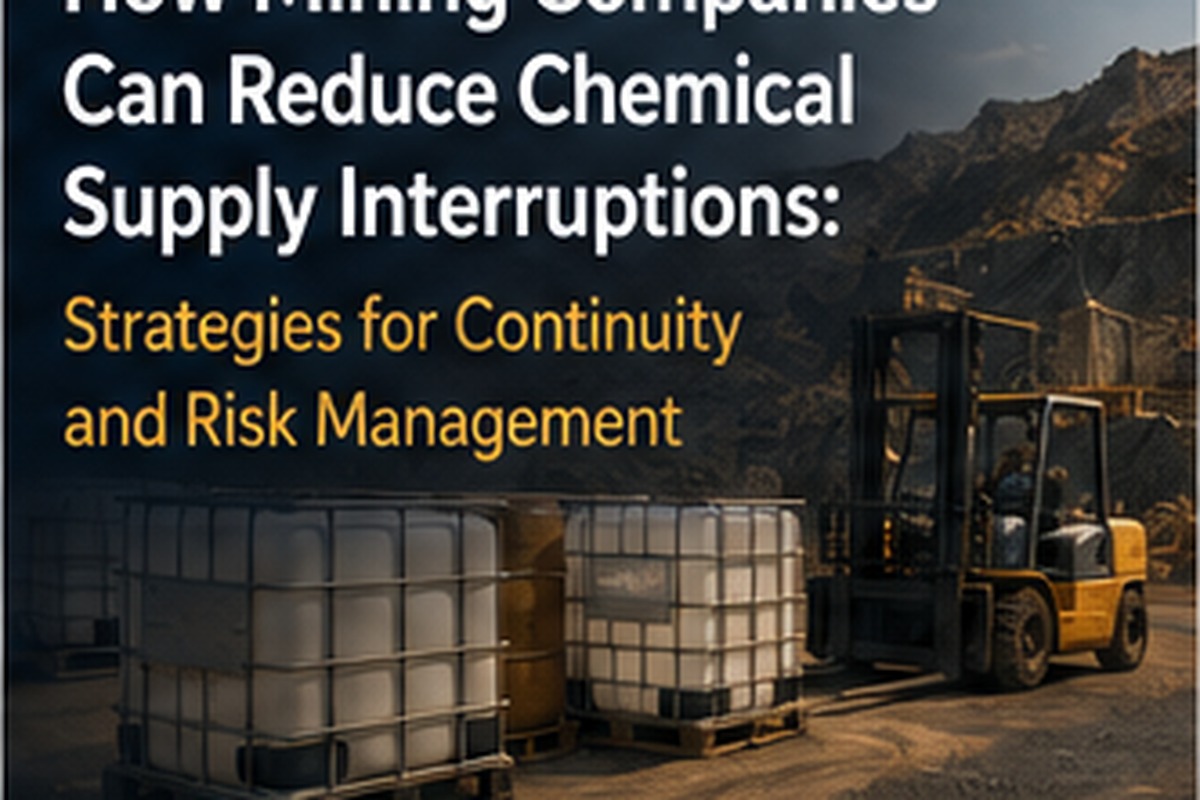
The shortage usually starts weeks before anyone calls it an emergency
A mine can have millions of cedis worth of equipment available and still lose productive time because a comparatively modest chemical did not arrive. That is what makes reagent supply risk so unforgiving. The value of the chemical and the value of the process it supports are often completely different numbers.
By the time stores reports that only a few days of stock remain, the real failure may already be several weeks old. Perhaps consumption increased and the reorder point was never adjusted. Perhaps an imported shipment slipped. Perhaps the backup supplier existed on paper but had never been technically approved. For a closer look at this part of the procurement process, our guide on how to Calculate Reorder Points for Industrial Chemicals explains the practical considerations in more detail.
Good continuity management is about finding those problems while there is still time to solve them cheaply.
First decide which chemicals can actually stop you
Not every chemical deserves a warehouse full of safety stock. Some products are easy to replace, have several qualified sources or are used in small quantities. Others can constrain production, water treatment, environmental compliance or product quality within days. For a closer look at this part of the procurement process, our guide on safety Stock for Industrial Chemicals: How Much Is Enough explains the practical considerations in more detail.
A useful criticality review asks four practical questions: How quickly do we consume it? How long does replacement really take? How many technically approved sources do we have? What happens operationally if we run out?
Once those answers are visible, procurement can spend working capital where it protects the business instead of applying the same stock rule to everything.
Quoted lead time and real lead time are often two different things
A supplier may quote four weeks, but what does four weeks actually mean? Four weeks from purchase order to dispatch? Four weeks to the port? Four weeks to the mine gate?
For imported chemicals coming into Ghana, the journey can include manufacturing allocation, documentation, vessel schedules, port processes and inland transport. Any one of those stages can move. For the wider context, our guide on mining Chemicals in Ghana: A Practical Guide to Reagents, Supply and Process Risk brings the main procurement considerations together in one place.
Procurement should keep the promised lead time, but it should plan from actual delivery history. If a supposedly four-week supply regularly takes six, the inventory policy should reflect six. Hope is not safety stock. For a closer look at this part of the procurement process, our guide on supplier Delivery Performance: Metrics That Protect Chemical Supply Continuity explains the practical considerations in more detail.
Days of cover is a wonderfully uncomfortable number
A warehouse balance of 40 tonnes sounds reassuring until someone explains that the plant is consuming eight tonnes a day. Expressing critical inventory as approximate days of cover makes the situation immediately understandable to operations, finance and management.
It also responds naturally to changing consumption. If throughput rises or ore conditions push reagent dosage upward, the number of days remaining falls even when the reorder quantity has not changed.
A simple dashboard showing stock on hand, recent average consumption, open purchase orders and expected arrival dates can prevent a surprising number of emergency phone calls.
A backup supplier you have never tested is not yet a backup
This is one of the easiest traps in chemical procurement. A company has two or three supplier names in its database and assumes it has resilience. Then the primary source fails and the alternative product has never been tested against the plant.
Depending on the reagent, qualification may be as simple as confirming a controlled specification and documentation, or it may require samples, laboratory work and a plant trial. That work is far easier to conduct when the primary supply is healthy.
The worst time to discover that an alternative reagent changes dosage or process behaviour is when the mine has three days of stock left.
Dual sourcing should reduce risk, not introduce randomness
There is a difference between dual sourcing and buying whatever is available. Proper dual sourcing keeps suppliers inside an approved technical envelope. The mine knows what each product is, how it performs and what documentation accompanies it.
Random spot buying can solve today’s shortage while creating tomorrow’s quality problem. Packaging may be incompatible, concentration may differ or operators may need to adjust dosage unexpectedly.
Flexibility is valuable, but controlled flexibility is far more valuable.
Bring suppliers into the forecast before you need a favour
Suppliers make better stocking and import decisions when they have some visibility of expected demand. A rolling forecast does not have to be a guaranteed purchase order. It simply gives both sides a common view of likely consumption.
For recurring chemicals, supplier reviews can cover expected demand, local stock, open orders, shipments in transit and known constraints. That conversation is much more useful than calling only when something is already late.
A good supplier should be able to tell the buyer where the risk is before the buyer has to ask.
Continuity has a price, but interruption has one too
Extra safety stock ties up working capital. A second qualified supplier may not always offer the absolute lowest price. Local inventory may carry a premium over a long-planned direct import.
Those costs should be challenged, but they should be compared with the cost of emergency freight, uncontrolled substitution, lost production or an environmental-treatment interruption.
The strongest mining procurement teams are not those that never experience supply problems. They are the teams that see trouble early enough to retain good options.
Discuss Your Chemical Requirement With Aviv Kitov Group
Aviv Kitov Group supports industrial organisations in Ghana with specialised chemical sourcing across regional and international markets. For a closer look at this part of the procurement process, our guide on single Sourcing vs Dual Sourcing for Critical Industrial Chemicals explains the practical considerations in more detail.
If you are comparing suppliers or planning a recurring requirement, send us the product, approved specification or grade, quantity, packaging, delivery location and required date. That gives our team enough context to assess realistic sourcing options.
Pingback: Lime in Gold Processing: pH Control, Consumption and Suppl