

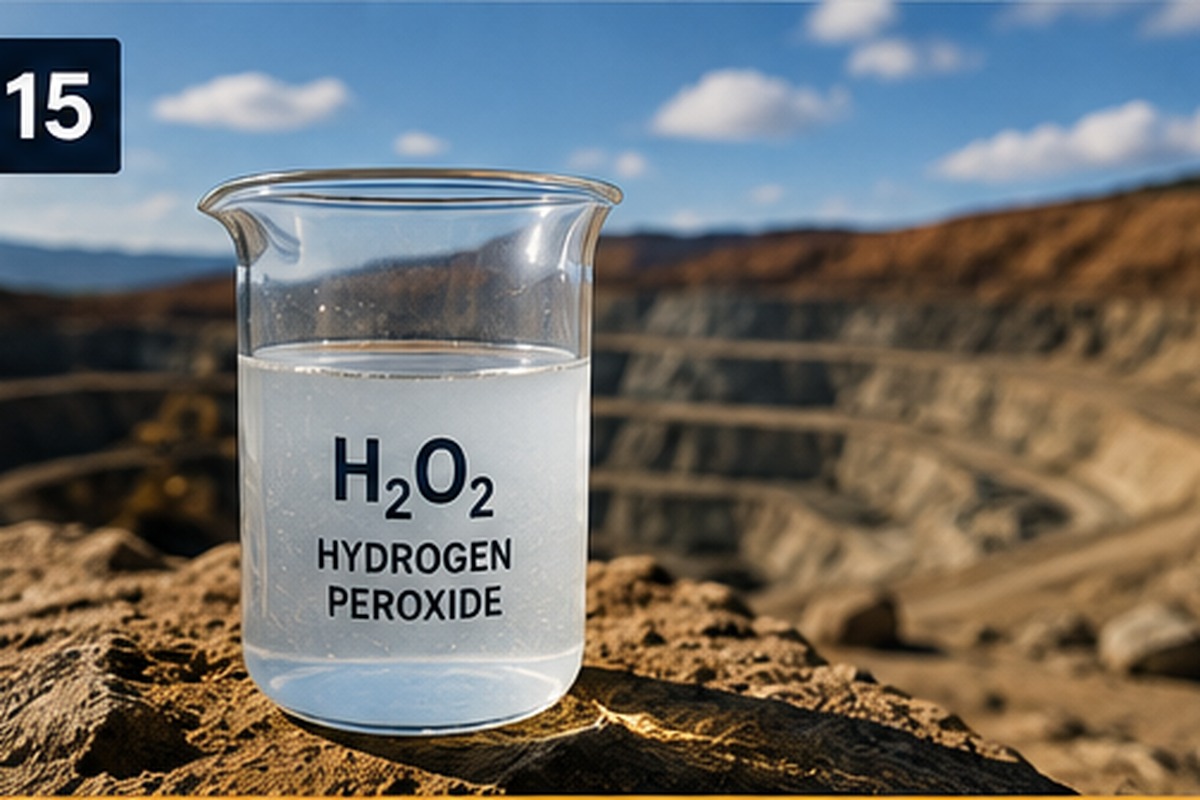
Hydrogen Peroxide Is a Powerful Industrial Oxidant
Hydrogen peroxide is used in mining and mineral processing where a controlled oxidising reagent is required. Applications can include water treatment, process oxidation and certain cyanide-treatment systems.
The product decomposes to water and oxygen, but that simple description should not create a false sense that concentrated peroxide is harmless. Industrial hydrogen peroxide is a reactive oxidiser that requires appropriate materials, storage, contamination control and trained handling.
Procurement therefore needs to work closely with process, HSE and engineering teams before changing concentration, supplier, packaging or delivery method.
Where Cyanide Detoxification Fits
Gold operations using cyanide need to manage residual cyanide in process solutions and tailings according to the site’s flowsheet, permits and environmental requirements. Several treatment technologies exist, and hydrogen peroxide can be used in selected oxidation-based approaches.
Whether peroxide is technically and economically suitable depends on cyanide species, solution chemistry, treatment targets, residence time and the overall process design. The treatment scheme should be established by competent technical personnel.
Procurement’s role is to supply the specified reagent consistently. It should not substitute one detoxification chemistry for another because a product is cheaper or more readily available. A useful next step is our guide on sodium Cyanide in Gold Mining: Procurement, Handling and Supply Considerations, which looks at the related practical considerations in more detail.
Concentration Must Be Explicit in the RFQ
Hydrogen peroxide is commercially available at different concentrations. The concentration affects the amount of active peroxide delivered, freight economics, storage requirements and handling risk.
A buyer comparing two quotations should therefore confirm that both suppliers are quoting the same concentration and specification. Where concentrations differ, cost per unit of active peroxide may provide a more useful commercial comparison than price per tonne of solution.
The RFQ should clearly state concentration, required grade, quantity, packaging or bulk format, delivery schedule, delivery location and required documentation.
Purity and Stability Matter
Industrial peroxide products are manufactured with controlled specifications and stabilisation systems. Contamination can accelerate decomposition, which is one reason storage and transfer systems need careful control.
Quality personnel should know which specification parameters matter to the process and what documentation is required at receipt. A Certificate of Analysis can support batch verification and traceability.
Supplier evaluation should include consistency as well as headline concentration. Unexpected variation can affect dosing calculations and treatment performance.
Storage Equipment Must Be Compatible
Hydrogen peroxide storage is not an ordinary chemical-storage decision. Tanks, vents, piping, pumps and transfer equipment must be suitable for the product and concentration being used.
Contamination with incompatible materials can create dangerous decomposition. Procurement should therefore never approve an alternative container, transfer arrangement or storage material without the appropriate engineering and HSE review.
The supplier’s Safety Data Sheet and technical handling guidance should be available before the product arrives.
Delivery Reliability Has Process Consequences
If peroxide supports an environmental treatment step, shortage risk may affect the plant’s ability to operate or discharge within its required controls. That makes continuity a process and compliance issue, not merely a purchasing inconvenience.
Inventory planning should use actual consumption and realistic replenishment lead time. Procurement should also understand the supplier’s local stock position, import cycle and contingency arrangements. A useful next step is our guide on lime in Gold Processing: pH Control, Consumption and Supply Planning, which looks at the related practical considerations in more detail.
A backup source should be technically qualified in advance. Emergency procurement is a poor time to discover that a replacement concentration or packaging format is incompatible with the site.
Measure the Cost of Treatment, Not Just the Drum
The commercial comparison should consider active concentration, dosage, freight, handling, storage and actual treatment performance.
If one product requires materially higher consumption to achieve the required treatment outcome, a lower unit price may not produce lower total cost. Process data should therefore inform supplier reviews.
The strongest procurement decision connects chemical cost with the treatment duty the reagent is expected to perform.
Keep Procurement Inside the Safety System
Hydrogen peroxide procurement should trigger the same cross-functional discipline as other hazardous process chemicals. HSE reviews hazards and emergency arrangements. Engineering confirms compatibility. Process personnel define the duty and concentration. Quality establishes acceptance criteria. Procurement manages the commercial and supply relationship. For the wider context, our guide on mining Chemicals in Ghana: A Practical Guide to Reagents, Supply and Process Risk brings the main procurement considerations together in one place.
That collaboration makes supplier changes faster to evaluate and much less likely to surprise the operation.
Discuss Your Mining Chemical Requirement With Aviv Kitov Group
Aviv Kitov Group supports mining and industrial organisations in Ghana with specialised chemical sourcing across regional and international markets. A useful next step is our guide on flocculants in Mineral Processing: How Polyacrylamide Supports Solid-Liquid Separation, which looks at the related practical considerations in more detail.
For a useful supply assessment, provide the product, technical specification or approved grade, quantity, packaging, delivery location and required date.
Our team can then assess sourcing options against the commercial and operational requirement.
For the fastest assessment, include:
- product or reagent required
- technical specification or approved grade
- quantity
- preferred packaging
- delivery location
- required delivery date
Pingback: Activated Carbon for Gold Recovery: How to Select It
Pingback: Caustic Soda in Gold Processing: Uses & Procurement