

The Lowest Unit Price Can Still Be the Expensive Option
A procurement comparison often begins with a simple number: price per kilogram, tonne, drum or IBC. That number matters, but it does not tell the buyer what the chemical will actually cost the organisation.
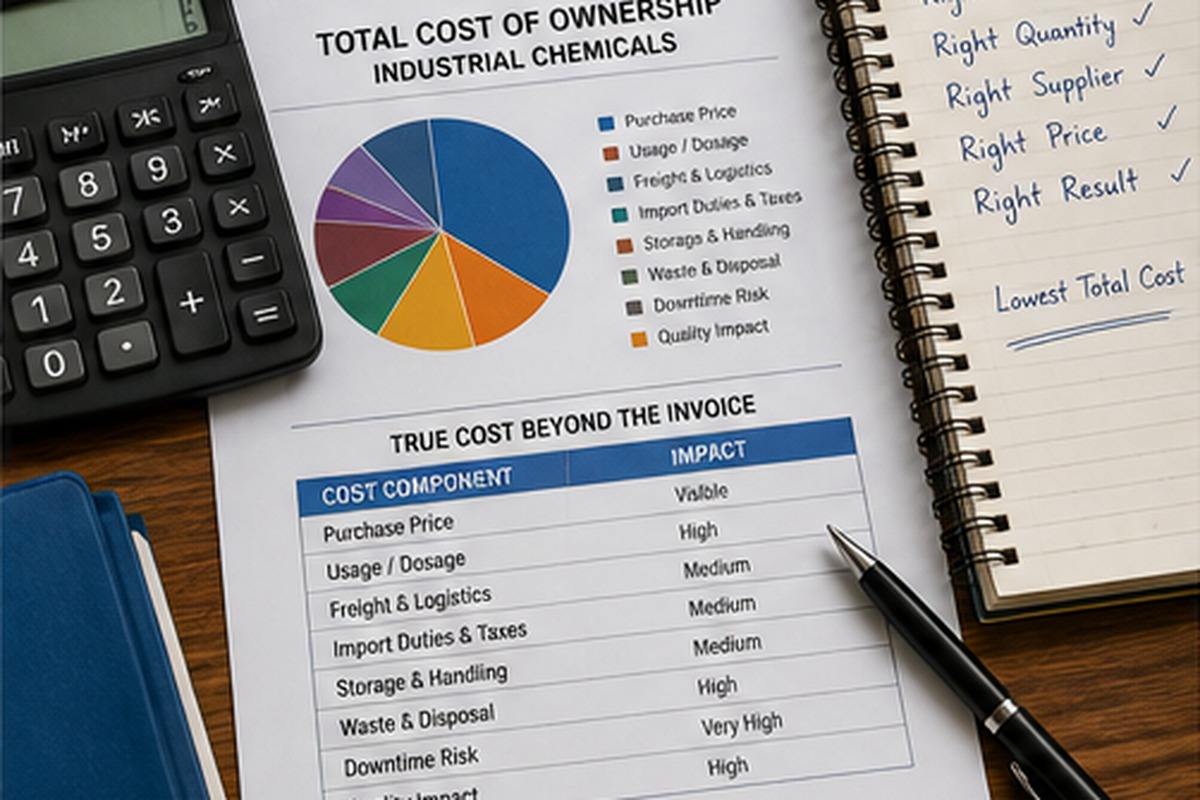
Industrial chemical total cost of ownership looks beyond the purchase order. It asks what the organisation spends to acquire, move, store, use and manage the product, and what operational cost can arise when quality or supply performance fails.
This does not mean every purchase needs a complicated financial model. It means the comparison should include the cost drivers that are large enough to change the decision.
Start With an Equivalent Technical Basis
Before comparing cost, confirm that the offers are technically comparable. Product name alone is not enough. Grade, concentration, purity, physical form, packaging and required standards may affect both performance and cost.
Consider two liquid products quoted at different prices per tonne. If one contains substantially more of the active material required by the process, comparing delivered tonnes can distort the result. A more useful measure may be cost per kilogram of active ingredient or cost per unit of treatment.
The correct basis depends on the application, but the principle is consistent: compare the economic unit the process actually consumes.
Component 1: Purchase and Landed Cost
The first layer includes the supplier price and the direct cost of getting the product to the required location. Depending on the sourcing model, that can include international freight, insurance, port and clearance costs, inland transport and handling.
For locally stocked products, some of these costs are already embedded in the supplier’s selling price. For direct imports, the buyer may carry them separately. A fair comparison therefore uses the cost at the point where the organisation actually receives usable stock.
Foreign exchange exposure also matters when supply is priced in a foreign currency. A quotation that remains open for a long lead time can move materially before payment or replenishment.
Component 2: Consumption and Dosage
This is where a seemingly small technical difference can overwhelm a price saving. If Product A is 8 percent cheaper per tonne but the plant needs 15 percent more of it to achieve the same result, the lower unit price has not produced a lower process cost.
Procurement and operations should therefore track actual consumption where performance can vary by supplier or grade. Useful measures include cost per tonne of finished product, cost per cubic metre treated, cost per tonne of ore processed or another unit that reflects the operation. A useful next step is our guide on chemical Procurement KPIs: What Industrial Buyers Should Measure, which looks at the related practical considerations in more detail.
The exact measure will differ between mining, water treatment, manufacturing and food processing, but the objective is the same: connect chemical spend to useful output.
Component 3: Inventory, Storage and Working Capital
Chemical inventory has a carrying cost. Larger safety stocks tie up cash and consume warehouse capacity. Special storage requirements can add infrastructure, segregation or containment costs.
At the same time, reducing inventory too aggressively can increase the probability of emergency purchasing or production interruption. The correct inventory level is therefore a balance between working capital and supply risk.
A supplier with reliable local stock may justify a higher unit price if that arrangement allows the customer to hold less inventory without increasing the risk of a stockout.
Component 4: Quality Variation and Process Impact
Quality inconsistency creates cost even when a batch is technically usable. Operators may adjust dosing, conduct additional testing, spend more time troubleshooting or experience variability in output.
More serious failures can create rejected deliveries, rework, disposal, production loss or urgent replacement purchases. These costs are easy to miss because they may appear in different departmental budgets.
A useful TCO review therefore includes supplier acceptance rate, batch consistency, complaint history and the operational consequences of off-specification material.
Component 5: Supply Reliability and Downtime Risk
Industrial buyers should assign economic importance to continuity. A supplier that saves a modest amount annually can destroy that saving with one serious missed delivery if the chemical is process-critical. A useful next step is our guide on how to Choose an Industrial Chemical Supplier in Ghana, which looks at the related practical considerations in more detail.
Not every risk needs to be converted into a precise probability model. Procurement can use scenarios. What would one day of shortage cost? Is there an approved alternative? How quickly can replacement stock be obtained? Is the supplier’s quoted lead time consistent with actual delivery history?
These questions make supply risk visible during the commercial decision rather than after a shortage.
A Practical TCO Scorecard
A simple comparison can use seven lines: delivered product cost, cost per useful active unit, expected consumption, inventory and storage impact, quality-related cost, supply-risk exposure and administrative or handling burden.
Some organisations will add environmental, waste or disposal costs. Others will include technical support, payment terms or financing. The model should reflect the operation, not become an academic exercise.
The important discipline is to write down the assumptions. If a supplier is selected because lower dosage is expected, measure dosage after implementation. If local stock is valued because it reduces emergency risk, track actual availability and delivery performance.
Use TCO to Negotiate Better, Not Simply to Pay More
Total cost of ownership is not an argument for choosing the highest-priced supplier. It is a method for identifying where value really comes from.
It can also strengthen negotiation. A buyer who understands concentration, consumption, lead time and quality can negotiate around the variables that matter instead of asking every supplier for the same percentage discount.
For industrial chemical procurement in Ghana, where imported supply, foreign exchange and logistics can materially affect availability and cost, TCO provides a more realistic basis for sourcing decisions than unit price alone. For the wider context, our guide on industrial Chemicals in Ghana: A Practical Guide for Procurement and Operations Teams brings the main procurement considerations together in one place.
Discuss Your Industrial Chemical Requirement With Aviv Kitov Group
Aviv Kitov Group supports industrial and mining organisations in Ghana with specialised chemical supply and strategic procurement across regional and international markets.
Our sourcing approach begins with the technical and operational requirement, then considers quantity, packaging, delivery timing, documentation and commercial conditions.
Send us the product, specification, quantity, preferred packaging, delivery location and required delivery date, and our team can assess suitable sourcing options.
For the fastest assessment, include:
- product or material required
- technical specification or grade
- quantity
- preferred packaging
- delivery location
- required delivery date
Pingback: Industrial Chemical Procurement in Ghana | Aviv Kitov
Pingback: Chemical Procurement Collaboration: A Practical Team Model