
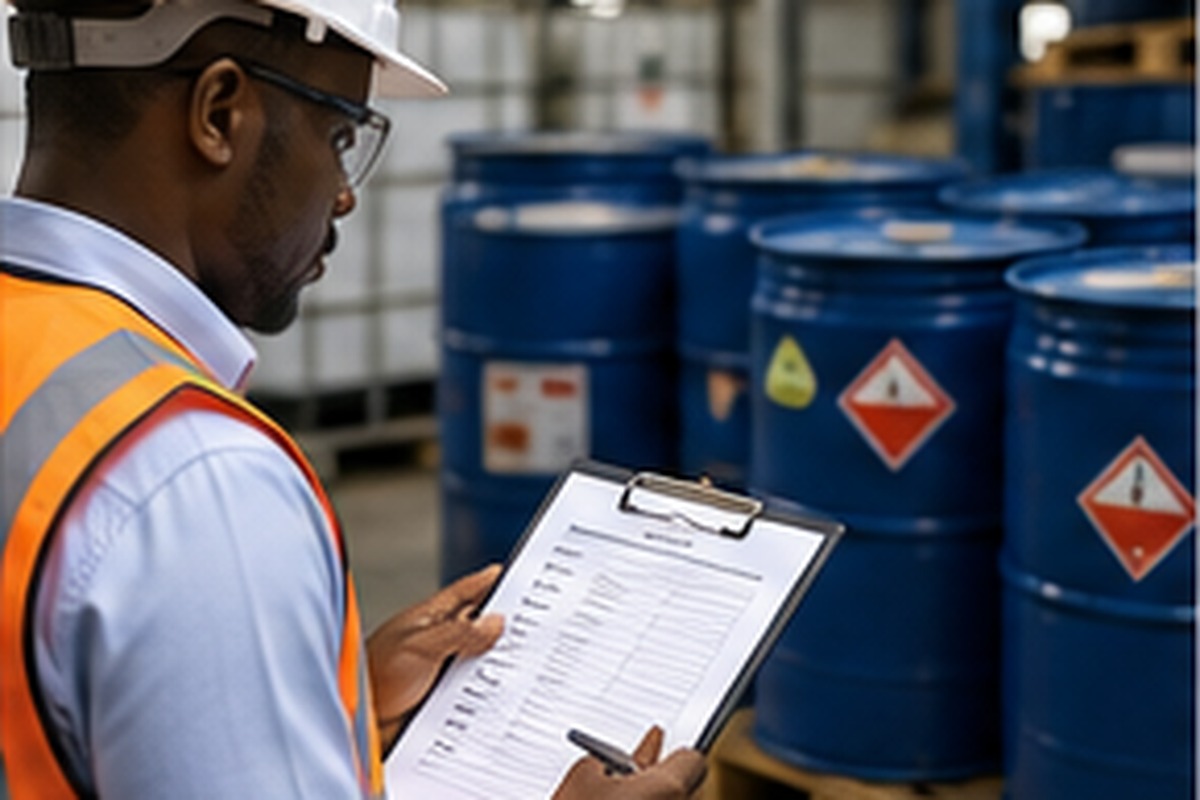
A supplier evaluation checklist helps procurement teams make decisions consistently. Without one, supplier selection can become too dependent on price, personal familiarity or whichever quotation arrives first. For industrial chemicals, that is risky because quality, documentation, logistics and handling can directly affect operations.
The purpose of a checklist is not to create paperwork for its own sake. It is to make sure the important questions are asked before the purchase order is issued. The following framework can be adapted by manufacturers, mines, water-treatment operations and other industrial buyers in Ghana. For the wider context, our guide on industrial Chemicals in Ghana: A Practical Guide for Procurement and Operations Teams brings the main procurement considerations together in one place.
1. Confirm the supplier’s identity and capability
Start with the basics. Confirm the legal business details you require for onboarding, the supplier’s physical presence, relevant contacts and the people responsible for commercial and technical matters. Then move quickly to capability. Does the company normally supply this product? Does it keep stock in Ghana? Is it importing against your order? What volumes can it realistically handle?
A supplier that is suitable for occasional small quantities may not be suitable for a plant that needs predictable monthly deliveries. Match the supplier’s demonstrated capacity to the importance of the chemical in your operation.
2. Verify the exact product specification
Write down the required chemical, grade, purity or concentration, physical form and packaging. Where the application has a specific standard or process requirement, include it. The supplier should confirm that its offer matches the requirement rather than simply repeating the generic chemical name.
Request appropriate product documents such as the Safety Data Sheet and Certificate of Analysis where relevant. For higher-risk purchases, consider whether independent testing or verification is necessary. Ghana Standards Authority states that its testing services cover manufacturers, importers and institutions, with its materials science laboratories performing analysis on general chemical-based materials and water among other products.
3. Review batch traceability and quality consistency
Ask how batches are identified and what information can be traced if a quality issue is discovered after delivery. If you purchase the same chemical repeatedly, consistency matters almost as much as the first successful delivery.
Procurement should also agree on the process for rejected or disputed material. Who investigates? What documentation is needed? Will the supplier replace material that does not meet the agreed specification? A clear process is much easier to establish before a dispute occurs.
4. Assess stock and replenishment
Find out whether the quoted quantity is physically available, expected in a future shipment or still to be ordered from an overseas manufacturer. Ask for realistic lead times and understand what could extend them.
For imports, clearance requirements matter. Ghana Revenue Authority identifies the Bill of Lading or waybill, attested invoice, packing list, Import Declaration Form and relevant regulatory permits among the documents that may be needed for clearance. A supplier that understands and prepares for this process is less likely to surprise you with avoidable delays.
5. Examine packaging, storage and transport
Check the proposed package size and material, whether the packaging suits your storage and dosing arrangements, and how the chemical will be transported to site. Damaged drums, poorly secured containers or unsuitable storage can turn a correct chemical into an operational problem.
Hazardous materials require additional attention. GPHA has publicly advised importers to complete the necessary processes and permits before hazardous cargo arrives and has emphasised safe onward transportation. Your supplier evaluation should therefore include evidence that the logistics plan is appropriate for the product being supplied.
6. Measure delivery reliability
Ask for evidence of the supplier’s ability to deliver when promised, particularly if the chemical is production-critical. For an existing supplier, use your own records. How many deliveries were on time? How often did quantities differ from the purchase order? How many emergency follow-ups were required?
A supplier can have an excellent catalogue and still be a poor operational partner. Actual delivery performance is more useful than promises once you have enough transaction history to measure it.
7. Review technical and after-sales support
Identify who answers product questions after the sale. The supplier should be able to provide documentation promptly and respond when there is a concern about a batch, package or specification. For more technical products, establish whether manufacturer support can be accessed when needed.
This does not mean every supplier needs a laboratory full of chemists. It means the supplier should have a credible route for getting accurate answers rather than improvising when a customer asks a technical question.
8. Compare commercial terms properly
Compare like with like. Check currency, taxes, delivery basis, payment terms, validity period, quantity, package size and whether transport is included. A lower unit price can disappear once freight, handling, financing, delays or additional testing are added.
Our article on why the cheapest chemical quote can become the most expensive explains why procurement teams should look at total cost and operational exposure rather than price in isolation.
9. Apply sector-specific requirements
Some industries have additional requirements. In Ghana’s mining sector, for example, the Minerals Commission’s local-content framework and procurement list affect how certain goods and services are sourced. The current framework includes activated carbon and domestic water treatment and supply of water-treatment chemicals and services among listed areas. A useful next step is our guide on local vs Imported Industrial Chemicals in Ghana: Which Sourcing Model Makes Sense, which looks at the related practical considerations in more detail.
Your checklist should therefore have a final section for requirements that apply specifically to your industry, site, customer standards or internal policies.
A simple scoring method
Procurement teams can score suppliers across quality and specification, documentation, supply capacity, delivery reliability, logistics, technical support, commercial terms and compliance. Weight the categories according to operational importance. A production-critical chemical should normally place more weight on specification and continuity than a non-critical consumable. A useful next step is our guide on why Procurement, Operations, HSE and Quality Must Work Together on Chemical Purchases, which looks at the related practical considerations in more detail.
The result is not meant to replace professional judgement. It gives that judgement a consistent structure. Used properly, a supplier evaluation checklist makes it easier to explain why a supplier was selected and easier to identify where an existing supplier needs to improve.
Planning an industrial chemical purchase in Ghana? Send your procurement requirement to Aviv Kitov Group and let us help you work through specification, sourcing, documentation and delivery.
Pingback: How to Choose an Industrial Chemical Supplier in Ghana